In human-aware planning and scheduling systems, when the agent recommends a plan or schedule to a human user, it is often the case that the user might not understand why the recommendation is good, for example, compared to an alternative in the user’s mind. In such a scenario, there is a need for the agent to explain its recommendation to the user, providing them with the necessary information to understand properties of the recommendation (e.g., optimality, feasibility, etc.).
We are approaching this problem from a knowledge representation and reasoning (KR) perspective, where we represent the mental models of both the agent and the human user using logical facts and rules. Within this framework, we adapt and generalize KR notions (e.g., entailment, hitting sets, model counting) to solve this problem.
To learn more, please see our invited talk on this topic, which we gave at University of Alberta. Slides available here.
Large language models are increasingly used as proxies for human cognition, but do they reason like humans when beliefs conflict with new evidence? We study this question through belief revision, that is, how agents update their beliefs in light of contradictions. Cognitive psychology has shown that humans favor explanation-based revision: they first generate explanations for the conflict, such as identifying conditions under which a general rule admits exceptions, and revise accordingly. In this paper, we develop a Bayesian model that decomposes this process into two orthogonal components: what to revise and how broadly to generalize to similar instances. We first run three human-subject experiments on simple, everyday abstract and grounded scenarios to evaluate how people revise their beliefs, and use this data to test our model’s predictions. We then evaluate three frontier LLMs on the same scenarios and show that while LLMs match human rule-targeting rates, they consistently fail to generalize: both humans and LLMs target the directly contradicted beliefs, but humans propagate revisions to related beliefs while LLMs revise only the directly contradicted instance—a gap present in both abstract and grounded settings.
@inproceedings{conf/colm/VasileiouRMY26,author={Vasileiou, Stylianos Loukas and Rago, Antonio and Martinez, Maria Vanina and Yeoh, William},title={Do Humans and {LLMs} Diverge in Belief Revision? Evidence from a {Bayesian} Analysis},booktitle={Conference on Language Modeling},pages={to appear},year={2026},}
AAMAS
Argumentative Human-AI Decision-Making: Toward AI Agents That Reason With Us, Not For Us
Stylianos Loukas Vasileiou, Antonio Rago, Francesca Toni, and
1 more author
In International Conference on Autonomous Agents and Multiagent Systems, 2026
Computational argumentation offers formal frameworks for transparent, verifiable reasoning but has traditionally been limited by its reliance on domain-specific information and extensive feature engineering. In contrast, LLMs excel at processing unstructured text, yet their opaque nature makes their reasoning difficult to evaluate and trust. We argue that the convergence of these fields will lay the foundation for a new paradigm: Argumentative Human-AI Decision-Making. We analyze how the synergy of argumentation framework mining, argumentation framework synthesis, and argumentative reasoning enables agents that do not just justify decisions, but engage in dialectical processes where decisions are contestable and revisable – reasoning with humans rather than for them. This convergence of computational argumentation and LLMs is essential for human-aware, trustworthy AI in high-stakes domains.
@inproceedings{conf/aamas/VasileiouRTY26,author={Vasileiou, Stylianos Loukas and Rago, Antonio and Toni, Francesca and Yeoh, William},title={Argumentative Human-AI Decision-Making: Toward AI Agents That Reason With Us, Not For Us},booktitle={International Conference on Autonomous Agents and Multiagent Systems},pages={3881--3886},year={2026},}
JAIR
On Generating Monolithic and Model Reconciling Explanations in Probabilistic Scenarios
Stylianos Loukas Vasileiou, William Yeoh, Alessandro Previti, and
1 more author
Explanation generation frameworks aim to make AI systems’ decisions transparent and understandable to human users. However, generating explanations in uncertain environments characterized by incomplete information and probabilistic models remains a significant challenge. In this paper, we propose a novel framework for generating probabilistic monolithic explanations and model reconciling explanations. Monolithic explanations provide self-contained reasons for an explanandum without considering the agent receiving the explanation, while model reconciling explanations account for the knowledge of the agent receiving the explanation. For monolithic explanations, our approach integrates uncertainty by utilizing probabilistic logic to increase the probability of the explanandum. For model reconciling explanations, we propose a framework that extends the logic-based variant of the model reconciliation problem to account for probabilistic human models, where the goal is to find explanations that increase the probability of the explanandum while minimizing conflicts between the explanation and the probabilistic human model. We introduce explanatory gain and explanatory power as quantitative metrics to assess the quality of these explanations. Further, we present algorithms that exploit the duality between minimal correction sets and minimal unsatisfiable sets to efficiently compute both types of explanations in probabilistic contexts. Extensive experimental evaluations on various benchmarks demonstrate the effectiveness and scalability of our approach in generating explanations under uncertainty.
@article{journals/jair/VasileiouYPS25,author={Vasileiou, Stylianos Loukas and Yeoh, William and Previti, Alessandro and Son, Tran Cao},title={On Generating Monolithic and Model Reconciling Explanations in Probabilistic Scenarios},journal={Journal of Artificial Intelligence Research},volume={84},number={5},pages={5:1--5:40},year={2025},}
NeurIPS
Model Reconciliation via Cost-Optimal Explanations in Probabilistic Logic Programming
Yinxu Tang, Stylianos Loukas Vasileiou, Vincent Derkinderen, and
1 more author
In Annual Conference on Neural Information Processing Systems, 2025
In human-AI interaction, effective communication relies on aligning the AI agent’s model with the human user’s mental model, a process known as model reconciliation. However, existing model reconciliation approaches predominantly assume deterministic models, overlooking the fact that human knowledge is often uncertain or probabilistic. To bridge this gap, we present a probabilistic model reconciliation framework that resolves inconsistencies in MPE outcome probabilities between an agent’s and a user’s models. Our approach is built on probabilistic logic programming (PLP) using ProbLog, where explanations are generated as cost-optimal model updates that reconcile these probabilistic differences. We develop two search algorithms – a generic baseline and an optimized version. The latter is guided by theoretical insights and further extended with greedy and weighted variants to enhance scalability and efficiency. Our approach is validated through a user study on explanation types and computational experiments showing that the optimized version consistently outperforms the generic baseline.
@inproceedings{conf/nips/TangVDY25,author={Tang, Yinxu and Vasileiou, Stylianos Loukas and Derkinderen, Vincent and Yeoh, William},title={Model Reconciliation via Cost-Optimal Explanations in Probabilistic Logic Programming},booktitle={Annual Conference on Neural Information Processing Systems},pages={to appear},year={2025},}
KR
A Methodology for Incompleteness-Tolerant and Modular Gradual Semantics for Argumentative Statement Graphs
Antonio Rago, Stylianos Loukas Vasileiou, Tran Cao Son, and
2 more authors
In International Conference on Principles of Knowledge Representation and Reasoning, 2025
Gradual semantics (GS) have demonstrated great potential in argumentation, in particular for deploying quantitative bipolar argumentation frameworks (QBAFs) in a number of real-world settings, from judgmental forecasting to explainable AI. In this paper, we provide a novel methodology for obtaining GS for statement graphs, a form of structured argumentation framework, where arguments and relations between them are built from logical statements. Our methodology differs from existing approaches in the literature in two main ways. First, it naturally accommodates incomplete information, so that arguments with partially specified premises can play a meaningful role in the evaluation. Second, it is modularly defined to leverage on any GS for QBAFs. We also define a set of novel properties for our GS and study their suitability alongside a set of existing properties (adapted to our setting) for two instantiations of our GS, demonstrating their advantages over existing approaches.
@inproceedings{conf/kr/RagoVTTY25,author={Rago, Antonio and Vasileiou, Stylianos Loukas and Son, Tran Cao and Toni, Francesca and Yeoh, William},title={A Methodology for Incompleteness-Tolerant and Modular Gradual Semantics for Argumentative Statement Graphs},booktitle={International Conference on Principles of Knowledge Representation and Reasoning},pages={500--511},year={2025},}
AAAI
Does Your AI Agent Get You? A Personalizable Framework for Approximating
Human Models from Argumentation-based Dialogue Traces
Yinxu Tang, Stylianos Loukas Vasileiou, and William Yeoh
In AAAI Conference on Artificial Intelligence, 2025
Explainable AI is increasingly employing argumentation methods to facilitate interactive explanations between AI agents and human users. While existing approaches typically rely on predetermined human user models, there remains a critical gap in dynamically learning and updating these models during interactions. In this paper, we present a framework that enables AI agents to adapt their understanding of human users through argumentation-based dialogues. Our approach, called Persona, draws on prospect theory and integrates a probability weighting function with a Bayesian belief update mechanism that refines a probability distribution over possible human models based on exchanged arguments. Through empirical evaluations with human users in an applied argumentation setting, we demonstrate that Persona effectively captures evolving human beliefs, facilitates personalized interactions, and outperforms state-of-the-art methods.
@inproceedings{conf/aaai/TangV025,author={Tang, Yinxu and Vasileiou, Stylianos Loukas and Yeoh, William},title={Does Your AI Agent Get You? A Personalizable Framework for Approximating
Human Models from Argumentation-based Dialogue Traces},booktitle={{AAAI} Conference on Artificial Intelligence},pages={14405--14413},year={2025},}
KR
Dialectical Reconciliation via Structured Argumentative Dialogues
Stylianos Loukas Vasileiou, Ashwin Kumar, William Yeoh, and
2 more authors
In International Conference on Principles of Knowledge Representation and Reasoning, 2024
We present a novel framework designed to extend model reconciliation approaches, commonly used in human-aware planning, for enhanced human-AI interaction. By adopting a structured argumentation-based dialogue paradigm, our framework enables dialectical reconciliation to address knowledge discrepancies between an explainer (AI agent) and an explainee (human user), where the goal is for the explainee to understand the explainer’s decision. We formally describe the operational semantics of our proposed framework, providing theoretical guarantees. We then evaluate the framework’s efficacy “in the wild” via computational and human-subject experiments. Our findings suggest that our framework offers a promising direction for fostering effective human-AI interactions in domains where explainability is important.
@inproceedings{conf/kr/VasileiouK0ST24,author={Vasileiou, Stylianos Loukas and Kumar, Ashwin and Yeoh, William and Son, Tran Cao and Toni, Francesca},title={Dialectical Reconciliation via Structured Argumentative Dialogues},booktitle={International Conference on Principles of Knowledge Representation and Reasoning},pages={777--787},year={2024},}
ECAI
A Logic-Based Framework for Explainable Agent Scheduling Problems
Stylianos Loukas Vasileiou, Borong Xu, and William Yeoh
In European Conference on Artificial Intelligence, 2023
Agent Scheduling Problems (ASPs) are common in various real-world situations, requiring explainable decision-making processes to effectively allocate resources to multiple agents while fostering understanding and trust. To address this need, this paper presents a logic-based framework for providing explainable decisions in ASPs. Specifically, the framework addresses two types of queries: reason-seeking queries, which explain the reasoning behind scheduling decisions, and modification-seeking queries, which offer guidance on making infeasible decisions feasible. Acknowledging the importance of privacy in multi-agent scheduling, we introduce a privacy-loss function that measures the disclosure of private information in explanations, enabling a privacy-preserving aspect in our framework. By using this function, we introduce the notion of privacy-aware explanations and present an algorithm for computing them. Empirical evaluations demonstrate the effectiveness and versatility of our approach.
@inproceedings{conf/ecai/VasileiouX023,author={Vasileiou, Stylianos Loukas and Xu, Borong and Yeoh, William},title={A Logic-Based Framework for Explainable Agent Scheduling Problems},booktitle={European Conference on Artificial Intelligence},pages={2402--2410},year={2023},}
ECAI
PLEASE: Generating Personalized Explanations in Human-Aware Planning
Stylianos Loukas Vasileiou and William Yeoh
In European Conference on Artificial Intelligence, 2023
Model Reconciliation Problems (MRPs) and their variant, Logic-based MRPs (L-MRPs), have emerged as popular methods for explainable planning problems. Both MRP and L-MRP approaches assume that the explaining agent has access to an assumed model of the human user receiving the explanation, and it reconciles its own model with the human model to find the differences such that when they are provided as explanations to the human, they will understand them. However, in practical applications, the agent is likely to be fairly uncertain on the actual model of the human and wrong assumptions can lead to incoherent or unintelligible explanations. In this paper, we propose a less stringent requirement: The agent has access to a task-specific vocabulary known by the human and, if available, a human model capturing confidently-known information. Our goal is to find a personalized explanation, which is an explanation that is at an appropriate abstraction level with respect to the human’s vocabulary and model. Using a logic-based method called knowledge forgetting for generating abstractions, we propose a simple framework compatible with L-MRP approaches, and evaluate its efficacy through computational and human user experiments.
@inproceedings{conf/ecai/Vasileiou023,author={Vasileiou, Stylianos Loukas and Yeoh, William},title={{PLEASE:} Generating Personalized Explanations in Human-Aware Planning},booktitle={European Conference on Artificial Intelligence},pages={2411--2418},year={2023},}
JAIR
A Logic-Based Explanation Generation Framework for Classical and Hybrid Planning Problems
Stylianos Loukas Vasileiou, William Yeoh, Tran Cao Son, and
3 more authors
In human-aware planning systems, a planning agent might need to explain its plan to a human user when that plan appears to be non-feasible or sub-optimal. A popular approach, called model reconciliation, has been proposed as a way to bring the model of the human user closer to the agent”s model. To do so, the agent provides an explanation that can be used to update the model of human such that the agent’s plan is feasible or optimal to the human user. Existing approaches to solve this problem have been based on automated planning methods and have been limited to classical planning problems only.
In this paper, we approach the model reconciliation problem from a different perspective, that of knowledge representation and reasoning, and demonstrate that our approach can be applied not only to classical planning problems but also hybrid systems planning problems with durative actions and events/processes. In particular, we propose a logicbased framework for explanation generation, where given a knowledge base KBa (of an agent) and a knowledge base KBh (of a human user), each encoding their knowledge of a planning problem, and that KBa entails a query q (e.g., that a proposed plan of the agent is valid), the goal is to identify an explanation ⊆KBa such that when it is used to update KBh, then the updated KBh also entails q. More specifically, we make the following contributions in this paper: (1) We formally define the notion of logic-based explanations in the context of model reconciliation problems; (2) We introduce a number of cost functions that can be used to reflect preferences between explanations; (3) We present algorithms to compute explanations for both classical planning and hybrid systems planning problems; and (4) We empirically evaluate their performance on such problems. Our empirical results demonstrate that, on classical planning problems, our approach is faster than the state of the art when the explanations are long or when the size of the knowledge base is small (e.g., the plans to be explained are short). They also demonstrate that our approach is efficient for hybrid systems planning problems.
Finally, we evaluate the real-world efficacy of explanations generated by our algorithms through a controlled human user study, where we develop a proof-of-concept visualization system and use it as a medium for explanation communication.
@article{journals/jair/VasileiouYSKCM22,author={Vasileiou, Stylianos Loukas and Yeoh, William and Son, Tran Cao and Kumar, Ashwin and Cashmore, Michael and Magazzeni, Daniele},title={A Logic-Based Explanation Generation Framework for Classical and Hybrid Planning Problems},journal={Journal of Artificial Intelligence Research},volume={73},pages={1473--1534},year={2022},}
ICAPS
VizXP: A Visualization Framework for Conveying Explanations to Users in Model Reconciliation Problems
Ashwin Kumar, Stylianos Loukas Vasileiou, Melanie Bancilhon, and
2 more authors
In International Conference on Automated Planning and Scheduling, 2022
Advancements in explanation generation for automated planning algorithms have moved us a step closer towards realizing the full potential of human-AI collaboration in real-world planning applications. Within this context, a framework called model reconciliation has gained a lot of traction, mostly due to its deep connection with a popular theory in human psychology, known as the theory of mind. Existing literature in this setting, however, has mostly been constrained to algorithmic contributions for generating explanations. To the best of our knowledge, there has been very little work on how to effectively convey such explanations to human users, a critical component in human-AI collaboration systems. In this paper, we set out to explore to what extent visualizations are an effective candidate for conveying explanations in a way that can be easily understood. Particularly, by drawing inspiration from work done in visualization systems for classical planning, we propose a visualization framework for visualizing explanations generated from model reconciliation algorithms. We demonstrate the efficacy of our proposed system in a comprehensive user study, where we compare our framework against a text-based baseline for two types of explanations – domain-based and problem-based explanations. Results from the user study show that users, on average, understood explanations better when they are conveyed via our visualization system compared to when they are conveyed via a text-based baseline.
@inproceedings{conf/icaps/KumarVBO022,author={Kumar, Ashwin and Vasileiou, Stylianos Loukas and Bancilhon, Melanie and Ottley, Alvitta and Yeoh, William},title={VizXP: {A} Visualization Framework for Conveying Explanations to Users in Model Reconciliation Problems},booktitle={International Conference on Automated Planning and Scheduling},pages={701--709},year={2022},}
AAAI
On Exploiting Hitting Sets for Model Reconciliation
Stylianos Loukas Vasileiou, Alessandro Previti, and William Yeoh
In AAAI Conference on Artificial Intelligence, 2021
In human-aware planning, a planning agent may need to provide an explanation to a human user on why its plan is optimal. A popular approach to do this is called model reconciliation, where the agent tries to reconcile the differences in its model and the human’s model such that the plan is also optimal in the human’s model. In this paper, we present a logic-based framework for model reconciliation that extends beyond the realm of planning. More specifically, given a knowledge base KB1 entailing a formula and a second knowledge base KB2 not entailing it, model reconciliation seeks an explanation, in the form of a cardinality-minimal subset of KB1, whose integration into KB2 makes the entailment possible. Our approach, based on ideas originating in the context of analysis of inconsistencies, exploits the existing hitting set duality between minimal correction sets (MCSes) and minimal unsatisfiable sets (MUSes) in order to identify an appropriate explanation. However, differently from those works targeting inconsistent formulas, which assume a single knowledge base, MCSes and MUSes are computed over two distinct knowledge bases. We conclude our paper with an empirical evaluation of the newly introduced approach on planning instances, where we show how it outperforms an existing state-of-the-art solver, and generic non-planning instances from recent SAT competitions, for which no other solver exists.
@inproceedings{conf/aaai/VasileiouP021,author={Vasileiou, Stylianos Loukas and Previti, Alessandro and Yeoh, William},title={On Exploiting Hitting Sets for Model Reconciliation},booktitle={{AAAI} Conference on Artificial Intelligence},pages={6514--6521},year={2021},}
JELIA
Model Reconciliation in Logic Programs
Tran Cao Son, Van Nguyen, Stylianos Loukas Vasileiou, and
1 more author
In European Conference on Logics in Artificial Intelligence, 2021
Inspired by recent research ε^+ in explainable planning, we investigate the model reconciliation problem between two logic programs \pi_a and \pi_h, which represent the knowledge bases of an agent and a human, respectively. Given \pi_a, \pi_h, and a query q such that \pi_a entails q and \pi_h does not entail q (or \pi_a does not entail q and \pi_h entails q), the model reconciliation problem focuses on the question of how to modify \pi_h, by adding + ⊆\pi_a to \pi_h and removing ε^- ⊆\pi_h from \pi_h such that the resulting program \hat\pi_h = (\pi_h ε^-) ∪ε^+ has an answer set containing q (or has no answer set containing q). The pair (ε^+, ε^-) is referred to as a solution for the model reconciliation problem (\pi_a, \pi_h, q) (or (\pi_a, \pi_h, \lnot q)). We prove that, for a reasonable selected set of rules ε^+ ⊆\pi_a there exists a way to modify \pi_h such that \hat\pi_h is guaranteed to credulously entail q (or skeptically entail \lnot q). Given that there are potentially several solutions, we discuss different characterizations of solutions and algorithms for computing solutions for model reconciliation problems.
@inproceedings{conf/jelia/SonNV021,author={Son, Tran Cao and Nguyen, Van and Vasileiou, Stylianos Loukas and Yeoh, William},title={Model Reconciliation in Logic Programs},booktitle={European Conference on Logics in Artificial Intelligence},pages={393--406},year={2021},}
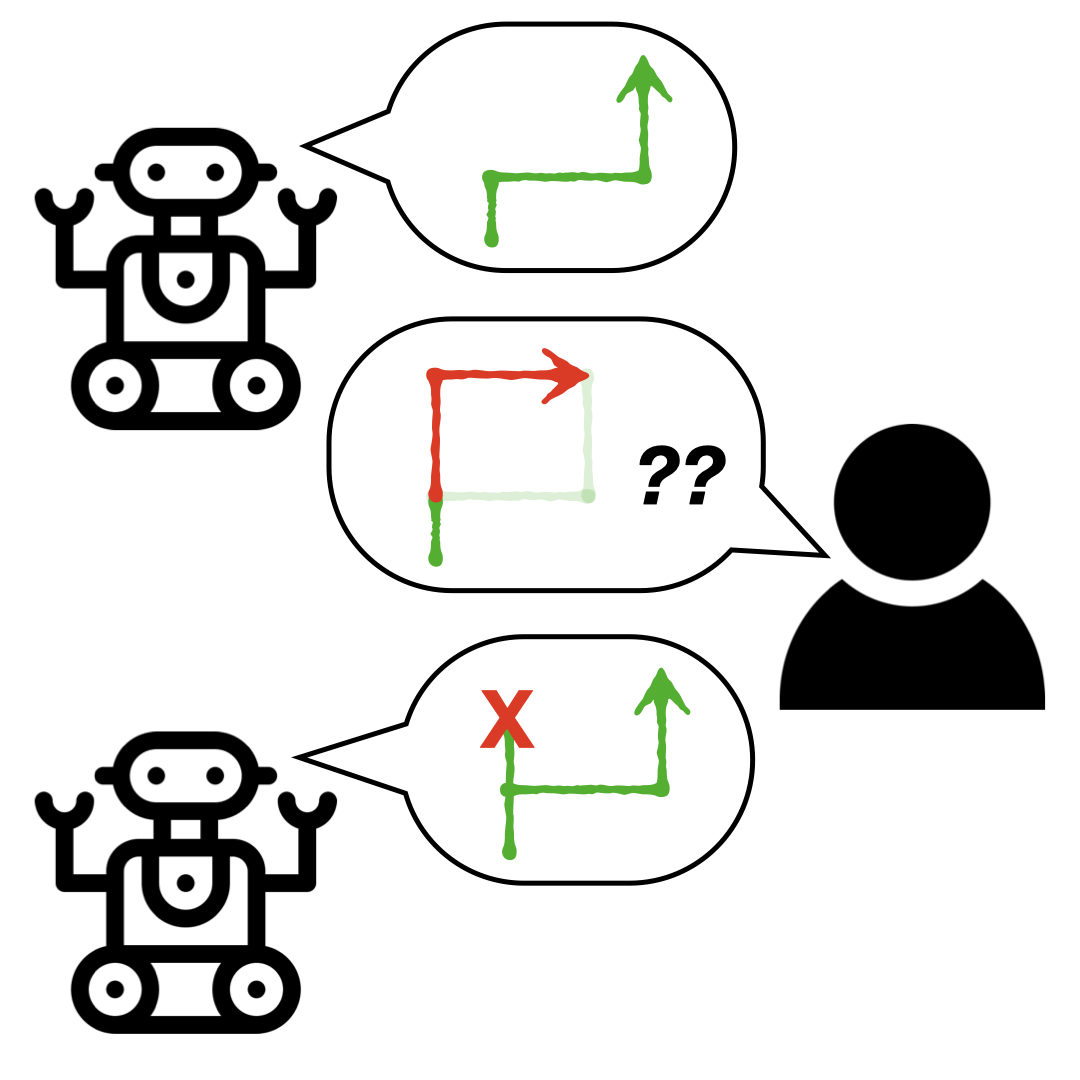 In human-aware planning and scheduling systems, when the agent recommends a plan or schedule to a human user, it is often the case that the user might not understand why the recommendation is good, for example, compared to an alternative in the user’s mind. In such a scenario, there is a need for the agent to explain its recommendation to the user, providing them with the necessary information to understand properties of the recommendation (e.g., optimality, feasibility, etc.).
 Collaborative Research: RI: Small: End-to-end Learning of Fair and Explainable Schedules for Court Systems.
 Explainable Distributed Constraint Optimization.
 Explainable and Privacy-Aware Decentralized Scheduling.
 Spotlight Presentation